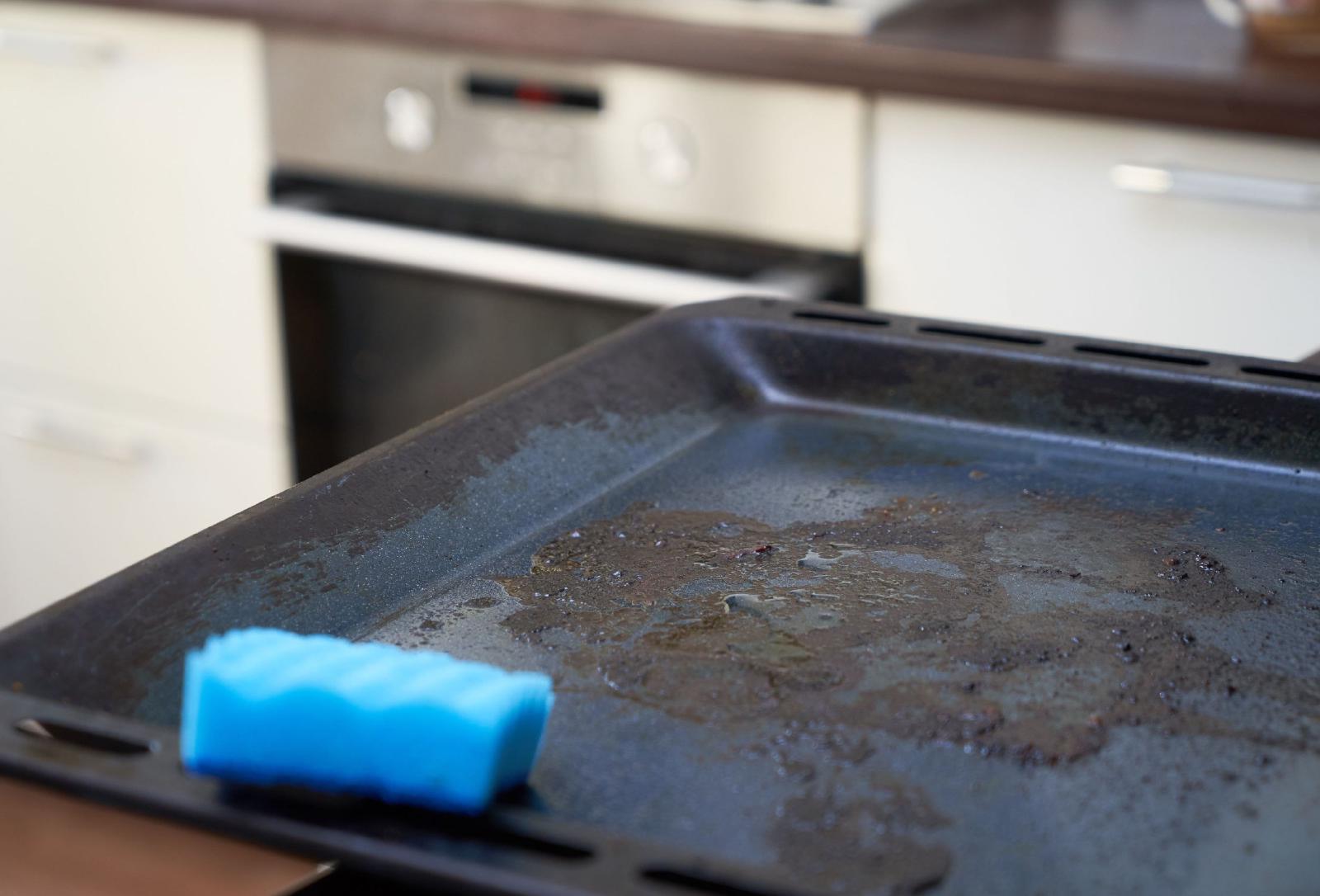
Why is cleaning baking sheets important?#
Regular cleaning of baking sheets offers many benefits:
- You get better baking results because clean sheets distribute heat more evenly.
- Unpleasant odours no longer develop.
- Regularly cleaned sheets are much easier to clean than heavily soiled ones — saving you time and effort.
Hygiene is another important reason for regular cleaning. A dirty, greasy baking sheet can become a breeding ground for bacteria and other germs that spread onto food and harm your health.
A good rule of thumb is to clean the baking sheet after every use. That prevents build-up of grease and food residue and keeps the sheet clean.
Which materials and methods are suitable?#
There are various materials and methods for effective, gentle cleaning of a baking sheet.
First, avoid sharp or abrasive tools such as steel wool or knives. Abrasive tools can damage the non-stick coating. Soft brushes or a sponge are better.
Note that depending on the material and coating of the sheet, some materials and methods may not be suitable. If you are unsure, check the manufacturer’s instructions before cleaning and use special cleaning products or methods if recommended. Some baking sheets have a special non-stick coating that scratches easily or can be damaged by excessive heat.
Recommended cleaning tools for baking sheets#
The following cleaning tools and materials are all available directly on Amazon.
Original Scrub Daddy (Affiliate: als Amazon-Partner profitieren wir von qualifizierten Verkäufen.)
Abwaschbürste mit integriertem Spülmittelspender von MR.SIGA (Affiliate: als Amazon-Partner profitieren wir von qualifizierten Verkäufen.)
Saugfähige Geschirrtücher aus 100 % Baumwollfrottee von Amazon, 8er Pack (Affiliate: als Amazon-Partner profitieren wir von qualifizierten Verkäufen.)
Essig Reiniger von Frosch, 3er Pack (Affiliate: als Amazon-Partner profitieren wir von qualifizierten Verkäufen.)
Recommended baking sheets#
If a baking sheet has been in use for many years, it can be difficult to clean completely. In such cases, you might want to buy a new sheet that is clean and hygienic. Here are our recommended replacement baking sheets you can order directly on Amazon:
Universelles Backblech von Siemens - robust, spülmaschinengeeignet, kratzunempfindlich und pyrolysefest (Affiliate: als Amazon-Partner profitieren wir von qualifizierten Verkäufen.)
Universelles Backblech von Neff, emaiilliert (Affiliate: als Amazon-Partner profitieren wir von qualifizierten Verkäufen.)
Cleaning baking sheets with salt#
One effective method is cleaning the baking sheet with salt. Salt is a popular natural cleaner and can remove dirt, grease, and other residue. It is gentler than aggressive cleaners that can damage the non-stick coating.
Further advantages#
- Cleaning with salt also neutralises odours. When you clean the baking sheet with salt, you can remove unwanted smells.
- Antimicrobial. Salt can reduce bacteria and other microorganisms on the surface of the baking sheet.
Disadvantage#
- It is not always enough to remove stubborn stains or crust. In that case, soak the baking sheet in warm soapy water or use another method.
Materials needed#
- Salt
- Water
- Wooden or rubber spatula
- Sponge
- Kitchen towel or paper towels
Instructions#
- Remove the baking sheet from the oven and preheat the oven to 50 to 100 degrees.
- Remove coarse dirt and crumbs from the baking sheet.
- Sprinkle a generous amount of salt on the sheet and put it back in the oven. The sheet should stay in the oven at about 100 degrees Celsius for roughly 10 to 15 minutes. When the salt has turned brown, you can remove the sheet from the oven.
- Let the baking sheet cool thoroughly. The crust should now come off easily.
- Remove the salt and crust with a kitchen spatula.
- Rinse the baking sheet with water and a sponge.
- Dry the baking sheet with a kitchen towel or paper towels.
Cleaning baking sheets with baking soda and vinegar#
Cleaning with baking soda and vinegar is a popular method. Baking soda is a mild cleaner with alkaline properties that can dissolve grease, dirt, and crust on the baking sheet. Vinegar is acidic and has descaling properties. When baking soda and vinegar come into contact, a reaction occurs that can loosen stubborn stains or crust. Baking soda and vinegar are a natural, eco-friendly alternative to aggressive cleaners with harmful chemicals.
Further advantages#
- The combination of baking soda and vinegar is an effective deep-cleaning method. Baking soda works well on stubborn dirt and crust, while vinegar helps dissolve grease and oil.
- Cleaning with baking soda and vinegar is eco-friendly.
- The application is simple and requires no special equipment or prior knowledge.
Disadvantage#
- Using vinegar when cleaning causes an unpleasant smell.
Materials needed#
- Baking soda or baking powder
- Vinegar
- Warm water
- Sponge or scrub brush
Instructions#
- Remove coarse dirt and crumbs from the baking sheet.
- Mix 50 grams of baking soda with warm water into a paste.
- Apply the paste to the baking sheet and let it sit for about 30 minutes.
- Spray the baking sheet with vinegar and let it sit for another 10 to 20 minutes.
- The dirt can now be removed easily with a sponge or scrub brush and a little water.
Cleaning baking sheets with citric acid#
Citric acid is also a popular method for cleaning baking sheets. Citric acid has descaling and grease-dissolving properties, with which you can remove stubborn dirt, grease, and crust from the baking sheet.
Further advantages#
- Citric acid is a natural, eco-friendly alternative to conventional cleaners with harmful chemicals.
- It neutralises odours. Citric acid has a refreshing effect and can reduce smells on the baking sheet.
- Cleaning with citric acid is simple. It requires no special tools or cleaning products.
Disadvantage#
- A major disadvantage of cleaning with citric acid is the aggressive acid, which can damage the non-stick coating.
Materials needed#
- Pure citric acid
- Sponge
- Warm water
- Kitchen towel or paper towels
Instructions#
- Remove the baking sheet from the oven.
- Remove coarse dirt and crumbs from the baking sheet.
- Spray citric acid over the entire baking sheet so all areas are well covered.
- Let the citric acid sit for at least 1 hour. The longer it sits, the better the result.
- Wipe the baking sheet with a sponge to remove the loosened dirt.
- Rinse the baking sheet with warm water and a sponge.
- Dry the baking sheet thoroughly with a kitchen towel or paper towels.
Cleaning baking sheets with dishwasher tabs#
Another popular method is cleaning baking sheets with dishwasher tabs. Dishwasher tabs contain enzymes and surfactants that dissolve grease and crust on the baking sheet, making this a quick and effective method.
Further advantages#
- No additional cleaning products are needed. A dishwasher tab contains everything to dissolve and remove grease and crust.
- The application is very simple. It requires no special tools or cleaning products. Dissolving the tab in water is enough.
- Fast cleaning.
Disadvantages#
- Only suitable for light soiling.
- Only suitable for a few baking sheets.
Materials needed#
- Hot water
- A little dish soap
- Dishwasher tab
- Sponge
Instructions#
- Bring water to a boil in a kettle and place a dishwasher tab on the baking sheet while it heats.
- Spread a little dish soap on the baking sheet and pour the boiled water over it. After a short soak, drain the hot water in the sink.
- If the baking sheet is not completely clean and residue remains, use a little dish soap and a sponge to finish. Wash the sheet and it is clean again!
- If the outside of your baking sheet is also dirty, you can submerge it in a large bucket or the bathtub and let it soak. Then hold it under water and wipe it clean.
Tips to prevent soiling#
Prevention is better than cure. To keep the baking sheet clean, line it with baking paper or a silicone mat before use. That prevents dough or other food from landing directly on the sheet and sticking.
Try to clean the baking sheet immediately after each use with a little dish soap and warm water. Crusted residue can also be removed with baking soda or vinegar. Dry well and store in a dry place.
Conclusion#
Regular cleaning of baking sheets is important for hygienic, flavourful baking results. Suitable materials and methods should be chosen according to the level of soiling and the sheet’s material. Salt, baking soda and vinegar, citric acid, and dishwasher tabs have proven effective as cleaners. The baking sheet should ideally be cleaned after every use, and heavily soiled sheets should receive a thorough clean. Avoid sharp objects to prevent scratches. Prevention improves cleaning, sustainability, and cooking quality. Regular cleaning extends the life of the sheet and ensures optimal baking results.
What do you think of the cleaning methods presented here? Do you have more tips or tricks you would like to share? Write to us in the comments below. We welcome feedback and suggestions.